
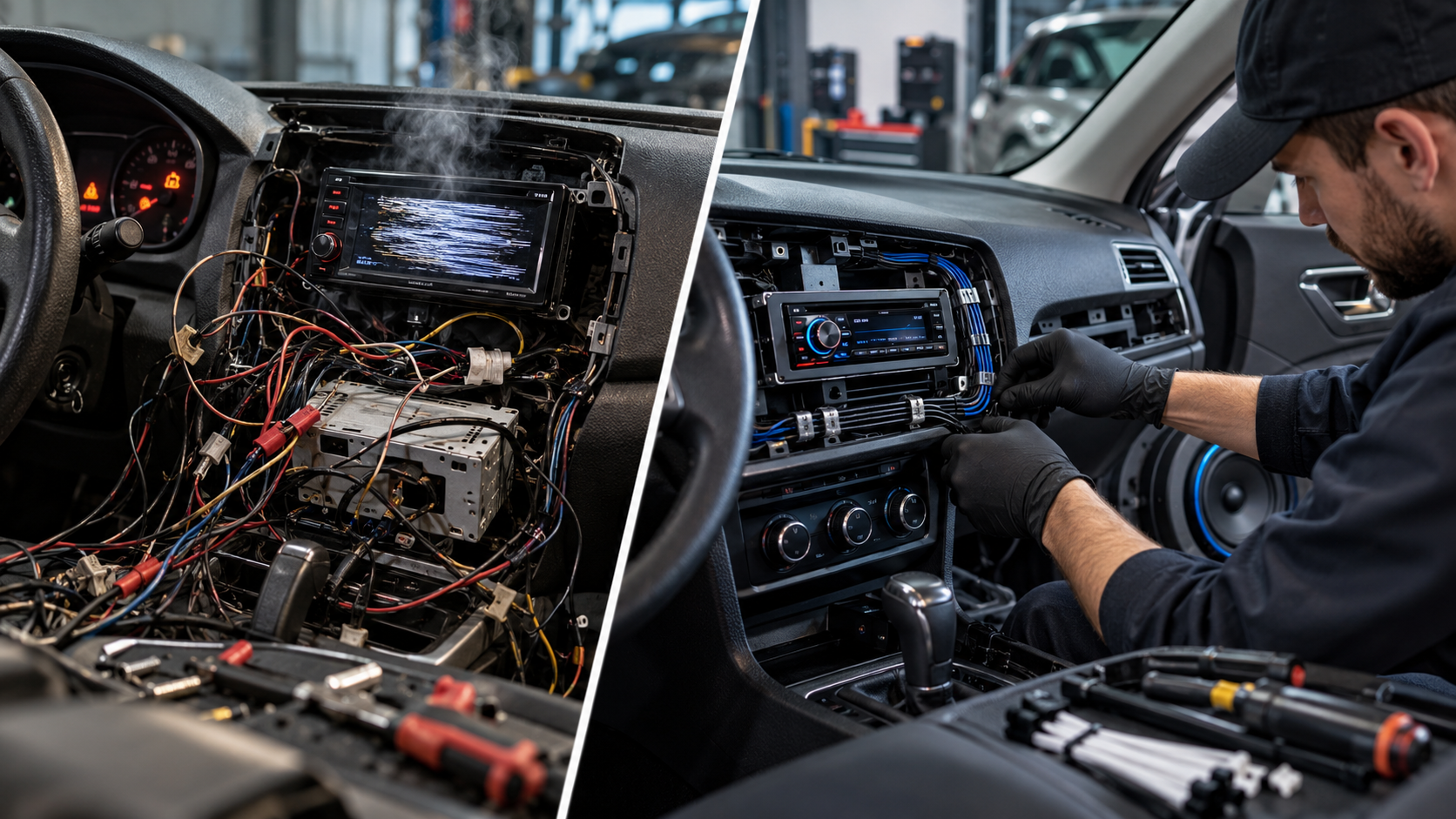
You spent money and time on a car audio install, only to face constant static, dead batteries, or electrical headaches. These issues don’t just ruin your drive—they signal something went wrong during installation. Our team specializes in car audio repair Indianapolis residents trust, and we’ll show you the five common mistakes that cause these problems and how we fix botched car audio installs for good.
Mistake #1: Poor Wire Connections and Improper Splicing
Why This Happens
Let’s talk about one of the biggest problems we see when fixing car audio systems. Poor wire connections are everywhere in DIY installs and cheap shop jobs. What happens is people get excited about their new system and rush through the wiring. They’ll twist wires together, slap some electrical tape on it, and call it a day. Or worse, they’ll use those cheap wire taps from the auto parts store that barely make contact.
Here’s the thing: your car audio system needs solid, clean connections to work right. When you’ve got loose wires or bad splices, you’re creating resistance in the circuit. That resistance causes all sorts of problems like static, distortion, and even complete system failure.
The Problems This Creates
Have you ever heard a popping sound through your speakers when you turn on your headlights? That’s often a grounding issue related to poor connections. Bad wire splices can also cause intermittent problems where your system works fine one day and acts up the next. The vibrations from driving shake loose connections even looser over time.
We’ve seen cases where people brought their cars to us after a “professional” install, and when we pulled the dash apart, we found wires literally held together with masking tape. No wonder they were having issues!
How We Fix It
When you bring your car to us for car audio repair Indianapolis style, we don’t just patch over bad connections. We redo them the right way. That means:
-
Stripping wires properly to expose clean copper
-
Using quality solder and heat shrink tubing for permanent connections
-
Crimping with professional-grade tools when appropriate
-
Testing every connection with a multimeter
-
Routing wires away from heat sources and moving parts
Our professional car audio troubleshooting process catches these issues before they cause bigger problems. We take the time to do it right because we know you’re counting on us.
Mistake #2: Incorrect Power and Ground Wiring
The Root of the Problem
This one’s huge. If we had a dollar for every time someone came in with a dead battery or blown fuse because of bad power wiring, we’d be rich. The power and ground wires are literally the foundation of your entire audio system. Get these wrong, and you’re asking for trouble.
A lot of DIYers don’t understand wire gauge. They’ll run a massive amplifier off a thin 16-gauge power wire because that’s what they had lying around. Or they’ll ground their amp to a rusty bolt under the seat and wonder why they’re getting engine noise through their speakers.
Cheap installers cut corners here too. They’ll tap into existing power sources that weren’t designed to handle the extra load. Or they’ll run the power wire right next to the signal cables, creating interference.
What Goes Wrong
Undersized power wires get hot. Really hot. We’re talking fire hazard hot. They also can’t deliver the current your amplifier needs, so your system underperforms and your amp goes into protection mode.
Bad grounds are just as problematic. When your ground connection is weak or corroded, your system tries to find alternative paths to complete the circuit. This creates ground loops, which give you that annoying whining noise that changes pitch with your engine RPM.
And let’s not forget about parasitic drains. If power wiring isn’t done correctly with proper fusing and a remote turn-on wire, your system can slowly drain your battery even when the car is off. You’ll come out to a dead battery on Monday morning and have no idea why.
Our Solution
When we fix car stereo wiring Indy residents bring to us, power and ground get special attention. We:
-
Calculate the correct wire gauge based on your amplifier’s current draw and wire length
-
Run dedicated power wires from the battery with proper inline fusing
-
Create solid ground connections to clean, bare metal
-
Use separate paths for power and signal cables to prevent interference
-
Install distribution blocks for multiple amplifiers
-
Check for proper voltage at every component
We also test the entire system for parasitic draw. Your battery should stay charged, period. If it doesn’t, we find out why and fix it.
Mistake #3: Damaged Speakers from Incorrect Amplifier Settings
Understanding the Issue
You know what’s frustrating? Buying nice speakers and having them blow out within weeks. This happens all the time, and it’s usually not the speaker’s fault. It’s because someone didn’t set up the amplifier correctly.
Many people think more power is always better, so they crank the gain (which they call “volume”) all the way up. But the gain control isn’t a volume knob. It’s an input sensitivity adjustment. When you set it wrong, you’re sending a distorted signal to your speakers. That distortion is what kills them.
We also see people mixing and matching components without checking impedance. They’ll wire speakers in a way that drops the load below what the amp can handle, causing the amp to overheat and send clipping signals to the speakers.
The Damage This Causes
Blown voice coils are the most common result. You’ll hear a scratching or buzzing sound, or the speaker might not work at all. Sometimes just the tweeter blows, leaving you with muddy, bass-heavy sound.
Clipping damage is particularly nasty because it’s not always obvious at first. Your speakers might sound okay at low volume but distort badly when you turn it up. The voice coil has been partially damaged, and it’s only a matter of time before it fails completely.
How We Handle Blown Car Speaker Repair
First, we test your speakers to confirm they’re actually blown and not just disconnected or suffering from a bad crossover. If they are damaged, we’ll either repair or replace them depending on the extent of the damage.
But here’s the key: we don’t just swap in new speakers and send you on your way. We figure out why they blew in the first place. That means:
-
Properly setting amplifier gain using an oscilloscope or multimeter
-
Checking impedance matching between amps and speakers
-
Configuring crossovers to protect tweeters from low frequencies
-
Setting subsonic filters to protect subwoofers
-
Verifying that your electrical system can support the power demands
Our blown car speaker repair service in Indianapolis includes making sure it doesn’t happen again. We educate you on proper volume levels and what to listen for that indicates problems.
Mistake #4: Skipping the Proper Integration with Factory Systems
Why This Is Tricky
Modern cars are complicated. They’re not like the vehicles from 20 years ago where you could just unplug the factory radio and plug in an aftermarket one. Today’s cars have integrated systems where the radio controls climate information, backup cameras, steering wheel controls, and more.
A lot of installers (especially DIYers) don’t realize this until it’s too late. They pull out the factory head unit and suddenly half the car’s features stop working. Or they bypass important modules and create problems with the vehicle’s computer system.
Even when people try to keep the factory radio and just add amplifiers and speakers, they often don’t use the right adapters or signal processors. This results in poor sound quality, turn-on pops, and compatibility issues.
The Complications That Arise
We’ve seen people lose their backup cameras, parking sensors, and even Bluetooth connectivity because of improper integration. Some factory systems use amplified outputs that can damage aftermarket equipment if you connect them wrong.
There’s also the issue of steering wheel controls. People love their steering wheel buttons, and they get upset when they don’t work anymore. Cheap installers either don’t bother hooking them up or do it incorrectly so they only partially function.
Factory amplified systems are another headache. Many cars have premium audio systems with external amplifiers. If you don’t bypass or work with these correctly, you’ll get no sound, distorted sound, or damage to your new equipment.
Our Integration Expertise
This is where professional car audio troubleshooting really pays off. We stay current on factory systems and know how to integrate with them properly. When we fix botched car audio install jobs involving factory integration, we:
-
Use vehicle-specific harnesses and adapters
-
Install signal processors to convert factory outputs when needed
-
Retain all factory features including cameras, sensors, and controls
-
Program steering wheel control interfaces correctly
-
Work with factory amplifiers or bypass them cleanly
-
Ensure compatibility with vehicle computer systems
We’ve invested in the tools and training needed to work with modern vehicles. Whether you’ve got a basic economy car or a luxury vehicle with a premium sound system, we know how to upgrade it without losing functionality.
Mistake #5: Inadequate or Missing Sound Deadening and Installation Hardware
The Often-Overlooked Problem
This mistake doesn’t cause electrical problems, but it ruins your sound quality and can create annoying rattles. A lot of installers skip sound deadening entirely because it’s time-consuming and they’re trying to keep costs down. Or they use cheap materials that don’t work well.
The same goes for mounting hardware. People use screws that are too long and puncture things they shouldn’t. Or they use screws that are too short and don’t hold properly. They’ll mount subwoofer boxes with a couple of wood screws and wonder why everything rattles apart after a few months.
Door speakers are particularly problematic. Without proper mounting brackets, they don’t seal correctly in the door. This causes phase cancellation where the sound from the back of the speaker interferes with the sound from the front, killing your bass response.
What You’ll Experience
Rattling panels are the obvious sign. Your door cards buzz, your dash vibrates, and your trunk lid shakes. It’s annoying and makes even expensive speakers sound cheap.
Without proper sound deadening, you also lose bass. Low frequencies need a sealed environment to sound their best. When your doors are full of holes and thin metal, the bass just leaks out and disappears.
Loose mounting can lead to physical damage too. We’ve seen subwoofers tear themselves apart because they weren’t secured properly and bounced around during driving.
Our Thorough Approach
When we do car audio repair Indianapolis customers can count on, we address the whole installation, not just the electrical parts. That includes:
-
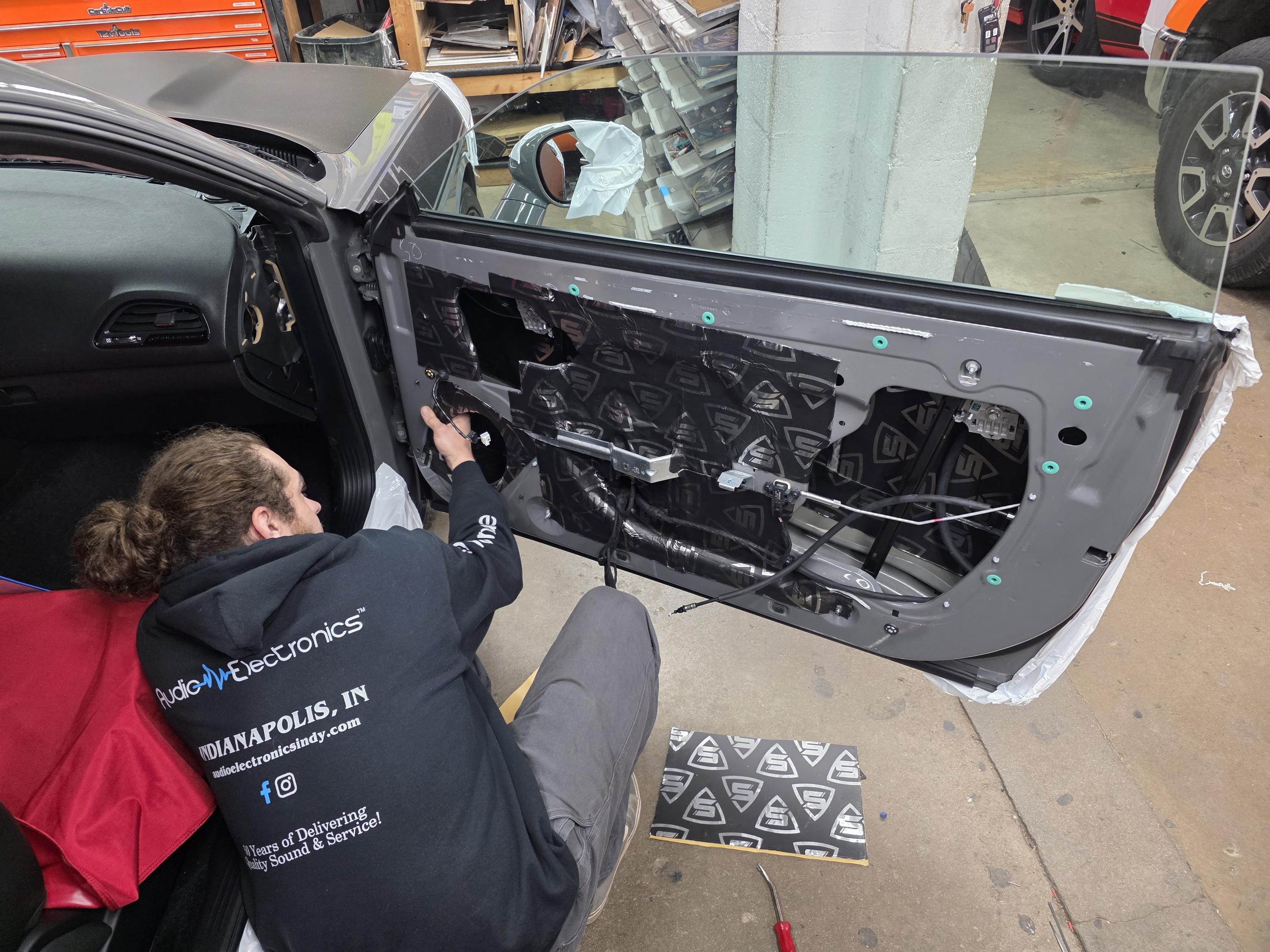
Applying quality sound deadening material to doors, trunk, and floor
-
Using proper speaker mounting brackets and baffles
-
Sealing door speakers with foam gaskets
-
Securing amplifiers with appropriate hardware
-
Building or reinforcing subwoofer enclosures
-
Eliminating panel rattles throughout the vehicle
We take the time to do it right because we know that proper installation hardware and sound treatment make a huge difference in how your system sounds and holds up over time.
Why Professional Installation and Repair Matters
The Real Cost of Cutting Corners
Let’s be honest about something. We get it. Professional installation costs more upfront than doing it yourself or going to the cheapest shop in town. But here’s what we’ve learned from years of fixing other people’s mistakes: cutting corners almost always costs you more in the long run.
Think about it. You pay for the initial install, then you pay for new speakers when they blow, then you pay a mechanic to track down electrical gremlins, then you finally pay us to fix everything properly. That’s three or four times what you would’ve paid to just do it right the first time.
And that’s not even counting the frustration. The days without music. The dead batteries. The annoying noises. Your time has value too.
What Sets Us Apart
When you choose our services to fix car stereo wiring Indy folks have struggled with, you’re getting more than just a repair. You’re getting:
-
Experienced technicians who’ve seen every type of installation mistake
-
Proper tools and testing equipment
-
Quality materials and components
-
Warranty on our work
-
Honest assessment of what needs to be fixed
-
Education so you understand your system
We’re not here to upsell you on stuff you don’t need. If your amplifier is fine and just needs proper settings, we’ll tell you that. If your speakers can be saved, we’ll save them. We treat your car like it’s our own.
Common Questions We Get About Car Audio Repairs
“Can You Really Fix My System, or Do I Need to Start Over?”
Most of the time, we can save your existing equipment. If you’ve got quality components that were just installed poorly, we’ll make them work right. We only recommend replacement when something is truly damaged beyond repair or when it makes more financial sense.
We’ll always give you options. Maybe we can get your system working acceptably for a small repair cost, or we can take it to the next level with some upgrades. You decide what makes sense for your budget and goals.
“How Long Does a Repair Take?”
It depends on what’s wrong. Simple fixes like adjusting amplifier settings or reconnecting a loose wire might take an hour. Complete rewiring of a botched install could take a full day or more.
We’ll inspect your system and give you a realistic timeline. We don’t rush repairs because that’s how mistakes happen. We’d rather take the time to do it right than have you back next month with the same problem.
“What If You Find More Problems Than Expected?”
We’ll call you before doing any additional work. If we quote you for fixing power wiring and we pull your dash apart and find that the signal cables are also a mess, we’ll let you know and give you a price for fixing those too.
Transparency is important to us. No surprise charges, no hidden fees. You approve the work before we do it.
Taking the Next Step
Don’t Let a Bad Install Ruin Your Drive
Life’s too short to deal with a car audio system that doesn’t work right. Whether you tried to install it yourself and got in over your head, or you went to a shop that didn’t know what they were doing, we can help.
Our car audio repair Indianapolis team has fixed hundreds of botched installs. We’ve seen every mistake in the book, and we know how to correct them. From parasitic battery drains to blown speakers to annoying static, we’ll track down the problem and solve it permanently.
What You Should Do Now
Give us a call or stop by our shop. Bring your car in and tell us what’s going on. We’ll do a thorough inspection and give you an honest assessment of what needs to be fixed.
You don’t have to live with a system that doesn’t work properly. Whether it’s minor troubleshooting or a complete fix of a botched car audio install, we’ve got the skills and experience to make it right.
Our Commitment to You
When you trust us with your vehicle, we take that seriously. We’re not just fixing wires and speakers. We’re giving you back the driving experience you wanted when you decided to upgrade your audio system.
Great sound in your car isn’t a luxury. It’s part of what makes driving enjoyable. Let us help you get there. With proper installation techniques, quality materials, and attention to detail, we’ll turn your audio nightmare into the system you dreamed of having.
Your car deserves better than a hack job. You deserve better than dealing with constant problems. Let’s fix it together and get you back to enjoying your music the way it’s meant to be heard.
Frequently Asked Questions
How much does it typically cost to repair a botched car audio installation?
Repair costs vary based on what needs fixing, but most jobs range from $100 to $500. Simple issues like reconnecting wires or adjusting settings are on the lower end, while complete rewiring or replacing damaged components costs more. We’ll inspect your system and provide a clear quote before starting any work so you know exactly what to expect.
What are the signs that my car audio was installed incorrectly?
The most common signs include constant static or distortion, dead batteries after the car sits overnight, speakers that cut in and out, popping noises when you turn the car on or off, and blown fuses. You might also notice rattling panels, loss of factory features like backup cameras, or engine noise through your speakers. Any of these symptoms suggest installation problems that need professional attention.
Can a bad car audio installation damage my vehicle’s electrical system?
Yes, absolutely. Improper wiring can cause parasitic battery drains, blow fuses, damage your alternator, or even create fire hazards from overheated wires. Bad grounds can send voltage where it shouldn’t go, potentially harming your car’s computer systems. That’s why it’s critical to have installation problems corrected quickly by someone who knows what they’re doing.
How long does professional car audio troubleshooting take?
Basic troubleshooting and diagnosis usually takes one to two hours. Simple repairs might be completed the same day, while more extensive fixes like complete rewiring can take four to eight hours or longer depending on your vehicle and the extent of the problems. We’ll give you a realistic timeline after inspecting your system so you can plan accordingly.
Will fixing my botched install void my vehicle warranty?
Properly done repairs won’t void your warranty, but the original bad installation might have already created warranty issues. We use professional techniques and vehicle-specific adapters that maintain your factory systems and keep everything up to manufacturer standards. If you’re concerned about warranty coverage, we’re happy to discuss how we’ll protect your vehicle’s integrity during repairs.